
Vail Valley Water Damage Guide
Hidden Leaks in Vail Homes: How Leak Detection Works and When to Call
Last week's snow and this week's rain are finding every weak point in Vail roofs, walls, and pipes. Here are the signs of a hidden leak, how moisture meters and thermal imaging locate the source without tearing out walls, and when a plumber should be your first call.
- 24/7 emergency response
- IICRC-certified technicians
- Insurance claim documentation
- Vail Valley + Eagle County
In this guide
- Local risks specific to mountain properties
- Practical first 60 minutes after damage
- When to call DRS instead of going DIY
Last week brought the first winter weather advisory of the season to Vail, with 4 to 8 inches on the mountain and a hard freeze in the valley. This week it is raining on top of that snow, with highs in the 50s through Tuesday and colder air and more snow behind it by Friday. Freeze, thaw, rain: that cycle is the best leak finder there is, and it is why October is when hidden water damage in Vail homes tends to show itself. A stain that appears on a ceiling this week may come from a roof, a pipe in the wall, a deck ledger, or a window that has been letting water in since August. Finding the real source is the first step in any water damage restoration job, and it is what leak detection is for.
This guide covers the signs of a leak you cannot see, the tools DRS uses to locate it in Vail homes and condos, and when a plumber should be your first call instead.
Signs of a hidden leak
- A stain that grows. Photograph it with a date. If the edge moves over a week, the source is active.
- Paint that bubbles or drywall that feels soft. Water has been behind it long enough to break the bond.
- A musty smell in one room. Mold needs moisture. The smell marks the room, not necessarily the spot.
- A water bill that climbed with no change in use. A supply-line leak runs around the clock.
- The meter moves when nothing is on. Shut every fixture, read the meter, wait an hour, read it again.
- Warm spots on a floor. In-floor radiant heat is common in Vail. A warm patch where there is no tubing, or an unusually warm patch, can mean a leaking loop.
- Cupped hardwood or lifting tile. Wood swells on the wet side first.
- A boiler that needs frequent makeup water. The water is going somewhere.
Where Vail homes leak
- Roof-to-wall and deck connections. Mountain homes have complex rooflines. Flashing where a dormer meets a slope, or where a deck ledger bolts to the house, is the most common entry point we find.
- Windows and doors on the weather side. Wind-driven rain gets past old sealant and runs down inside the wall.
- Supply lines inside exterior walls. A pinhole in a copper line, or a fitting that froze slightly last winter and has been weeping since.
- Condo stacks. In a multi-unit building, the water on your ceiling is often the unit above. A tub overflow, a failed shower pan, or a dishwasher line two floors up.
- Snowmelt systems and hose bibs. Heated driveway loops and exterior spigots that were not drained before the first freeze.
How leak detection works
Leak detection is the process of finding the source without tearing the house apart to look for it. DRS technicians use a few tools together, because no single one tells the whole story.
- Moisture meters. A pin meter reads the moisture content inside drywall or wood. A pinless meter scans a wall quickly without leaving marks. Readings are mapped room by room to show how far the water has traveled, which often is not where the stain is.
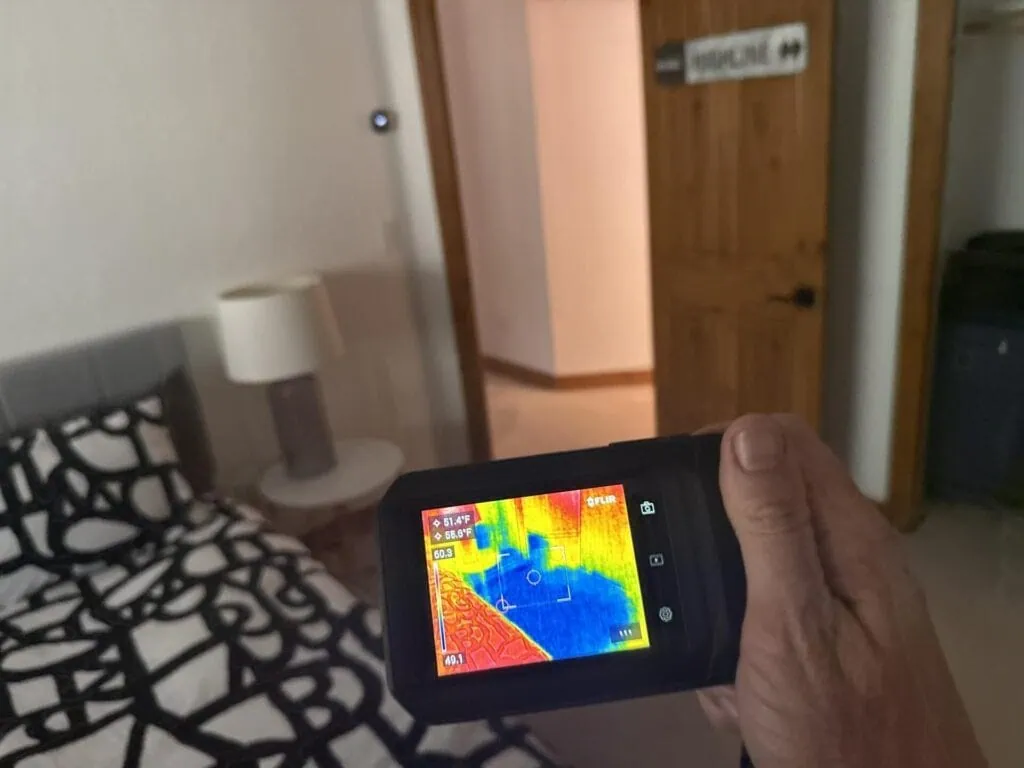
- Thermal imaging. An infrared camera shows temperature differences. Wet material is cooler than dry material because evaporation pulls heat, so a wet area behind paint shows as a cold shape on the screen. In a home with radiant floors, the camera also shows the tubing pattern, and a gap or a hot spot in it points to a problem.
- Hygrometers. Relative humidity in the air of a room, compared with the rest of the house. A closed bathroom at 70 percent humidity with the fan off is normal. A bedroom at 70 percent is not.
- Water testing. For roofs, windows, and decks, a controlled spray on one area at a time while someone watches inside. It is slow, and it is how you prove which joint is leaking.
- Pressure testing. For supply lines and radiant loops, the system is isolated and pressurized, and the gauge shows whether it holds. This is plumber territory, and we coordinate with them.
The output is a moisture map: a drawing of the affected rooms with readings marked, which tells you exactly what needs to be opened up and dried, and nothing more. In a Vail condo with a wet ceiling, that map might show the water came from a shower pan upstairs and traveled eight feet along a joist before it dripped. Without it, the ceiling gets patched and the drip comes back in a month.
When to call a plumber first
If water is actively running, or you can hear it in a wall, or the meter spins with everything off, shut the main and call a plumber. The leak needs to stop before anything can dry. If the water has already stopped and you are dealing with what it left behind, a stain, a smell, a soft floor, call DRS. We find the extent of the damage, dry it, and bring in a plumber if the source turns out to be a pipe. Either way, calling both is not a mistake. A plumber fixes the pipe. A restoration crew deals with the water that got out.
What DRS does on site
Our crews are based in Eagle County and respond 24/7. A leak detection visit in Vail typically includes:
- Moisture mapping of every room near the stain, including the one above in a condo
- Thermal imaging of walls, ceilings, and floors
- Identification of the source, or a controlled water test to prove it
- A drying plan that opens only what is wet, with air movers and dehumidification
- A check for mold on anything that has been wet more than a couple of days
- Photos, readings, and a written scope for your insurer or HOA
Common mistakes Vail homeowners make
- Painting over the stain. It returns in weeks, and the drywall behind it keeps getting wetter.
- Assuming it is the roof. Water travels. A ceiling stain near an exterior wall is as likely to be a window or a deck ledger.
- Waiting for ski season to end. A leak that drips through the winter is a mold job by April.
- Not notifying the HOA in writing. In a condo, who pays depends on where the water came from and what the documents say. A dated email protects you.
When to call a pro versus handle it yourself
Checking the water meter, photographing a stain, and looking in the attic after this week’s rain are all things you can do today. Locating a leak inside a wall or under a floor, and knowing how much of the structure is wet, takes instruments and the experience to read them.
If this week’s rain and last week’s snow found a leak in your home, we can find where it is coming from. See how we serve Vail or request an inspection.
Why DRS for Vail Valley Properties
Local mountain team
Crews based in Eagle County who know how snowmelt, freeze-thaw cycles, and vacation-home patterns drive damage in the Vail Valley.
24/7 dispatch
Emergency response any hour, any day. We mobilize to stabilize, mitigate, and document damage as soon as we arrive on site.
Insurance documentation
Photos, moisture readings, scope of work, and reports your adjuster needs to move the claim forward without delays.
Core Restoration Services
Water, fire, smoke, and mold restoration for homes, condos, rentals, and mountain properties throughout the Vail Valley and Eagle County.
Emergency Services
Emergency response, damage stabilization, and fast dispatch when a property loss cannot wait.
View serviceWater Damage Restoration
Water extraction, structural drying, moisture monitoring, and mitigation after leaks, pipe bursts, and flooding.
View serviceFire Restoration
Cleanup for smoke, soot, and fire-related damage with a clear path from emergency response to reconstruction planning.
View serviceMold Restoration
Targeted mold remediation and moisture control to protect indoor air quality and reduce recurrence.
View serviceAreas We Serve
Tap a town to see local restoration support, common issues we see in the area, and how to reach DRS fast.
Frequently Asked Questions
How do you find a water leak inside a wall?
A moisture meter shows which parts of the wall are wet and how far the water has spread, and a thermal camera shows the cooler, wet area behind the paint. Together they point to the source, which is often several feet from the stain. For roofs and windows, a controlled water test confirms the exact entry point before anything is opened.
Should I call a plumber or a restoration company for a leak?
If water is still running, call a plumber to stop it. If the water has stopped and you are dealing with a stain, a smell, or soft material, call a restoration company to find the extent and dry it. On most jobs both are involved, and DRS coordinates with plumbers regularly.
Does thermal imaging always find a leak?
No. The camera shows temperature differences, not water itself, so a wet area that has reached room temperature can be invisible to it. That is why it is used alongside a moisture meter, which measures the material directly.
Who pays when a leak in the condo upstairs damages my unit?
It depends on the source of the water and on your HOA's governing documents and insurance. Report the damage to the HOA in writing right away, document it with dated photos, and contact your own insurance agent. DRS provides the moisture readings and photos both sides will ask for.
Leak You Cannot Find in Vail?
DRS locates hidden water with moisture mapping and thermal imaging, then dries only what is wet. Crews respond across Eagle County 24/7.